Your Chart
A natal chart is the map every timing question on this site is read against. It’s worth understanding what’s actually in it before you ask what a transit or a cycle means for you, because a chart is far more ordinary — and far more limited — than the mystical language around it usually suggests.
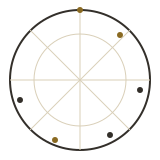
What a natal chart actually is
A natal chart is a map of where the Sun, Moon, and planets sat in the sky at the exact place and moment you were born. It’s plotted as a circle divided into twelve sections, called houses, with each planet placed in a sign and a house according to the sky at that moment. That’s the whole raw material. Everything called “interpretation” afterward is a set of traditions for reading that fixed arrangement — traditions that vary between astrologers, which is itself a useful reminder that a chart is a lens, not a verified instrument.
Because the chart is fixed at the moment of birth, it doesn’t update. It isn’t a live feed of your day; it’s closer to a fingerprint, taken once, and used afterward as a reference point against the sky’s ongoing movement — which is where transits and timing come in.
The three things most charts get asked about
The Sun sign is the one most people already know — the sign the Sun occupied on your birth date. It’s a broad-strokes description of temperament, and it’s the least specific piece of a full chart, since a billion or so other people share it with you.
The Moon sign describes an inner, more private register — how you process feeling rather than how you present. It changes roughly every two and a half days, which is why two people born the same date can have noticeably different charts.
The Ascendant, or rising sign, is set by your exact birth time and location — it’s the sign that was rising on the eastern horizon at that moment. It shapes the layout of the houses and is the single piece of a chart most sensitive to an inaccurate birth time, which is why a chart done with a guessed time should be read more loosely than one done with a documented one.
Beyond the big three: other placements that matter
A full chart has ten planets and twelve houses, and a serious reading looks at more than the Sun, Moon, and Ascendant, even if those three carry most of the everyday conversation. Mercury’s placement is read as describing how you think and communicate; Venus’s as what you’re drawn to and how you show affection; Mars’s as how you assert yourself and where your drive shows up. The outer planets — Jupiter, Saturn, Uranus, Neptune, Pluto — move slowly enough that they’re shared by everyone born within a few years of you, so they’re read more as generational texture than as something personal to you alone.
The houses matter as much as the planets. Each of the twelve houses is loosely associated with an area of life — the first with identity and how you present, the fourth with home and family, the seventh with partnership, the tenth with career and public standing, and so on. A planet’s house placement tells you roughly where its themes are likely to show up in your life, while its sign tells you more about the flavor of how those themes tend to play out.
How different traditions read the same chart
It’s worth knowing that “the” chart isn’t read identically everywhere. Western astrology, the tradition this site draws from, uses the tropical zodiac, anchored to the seasons rather than to the visible constellations. Vedic astrology uses a sidereal zodiac, anchored to the actual star positions, which shifts most placements by roughly twenty-three degrees compared to a Western chart for the same birth data. Neither is more “correct” in an absolute sense — they’re two different, internally consistent systems for organizing the same underlying sky, and mixing their vocabulary without saying so is a common source of confusing, contradictory-sounding readings.
Do you need an exact birth time?
For a full, house-by-house reading, yes — without it, the Ascendant and house placements can’t be calculated reliably, and any interpretation built on them is guesswork dressed up as precision. For a general seasonal read on a current transit or cycle, your birth date is usually enough, since many transits are read primarily against sign placements that don’t depend on the exact hour. If you don’t know your birth time, it’s worth saying so plainly rather than letting a chart imply more precision than it has.
What a chart is not
- It is not a personality test with guaranteed accuracy — it’s a traditional lens, and different astrologers read the same chart differently.
- It is not a medical, psychological, or diagnostic tool, and nothing on this site should be read as one.
- It is not a fixed script — the tendencies it describes are read as raw material you work with, not a set of instructions you’re required to follow.
- It is not proof of anything about another person unless you also have their accurate birth details, which most people don’t.
Reading a chart for a timing question
When the question is about timing rather than personality, the chart’s job shifts: it becomes the fixed reference point that a moving transit is measured against. A transit through your natal Sun’s sign reads differently than the same transit through your Moon’s sign, because it’s landing on a different part of your particular chart. This is why two people can experience “the same” astrological weather quite differently — the sky is shared, but the chart it’s landing on isn’t.
In practice, that means a useful timing question usually names both a life area (work, a relationship, a move) and, where possible, which part of your chart that area maps to. You don’t need to become a chart expert to ask a decent question — you mostly need to be specific about the decision, and let whichever reading tool you use do the mapping.
Where to go from here
If the vocabulary here is new, How Astrological Timing Works covers the basics of transits and seasons from the ground up. Once you’re comfortable with the chart itself, Transits & Retrogrades walks through the specific moving cycles that come up most often, and Timing a Decision shows how to put all of it together against an actual choice.